When Michael Dymond isn’t talking customers out of over-engineering their material specs, he’s tending three varieties of hot peppers, running a D&D campaign as Dungeon Master, or printing the weapons of the Fellowship of the Ring — life-size — on the Bambu printer in his home office. “Total 3D print and gardening nerd,” in his own words. That’s the onion we’re uncovering today.
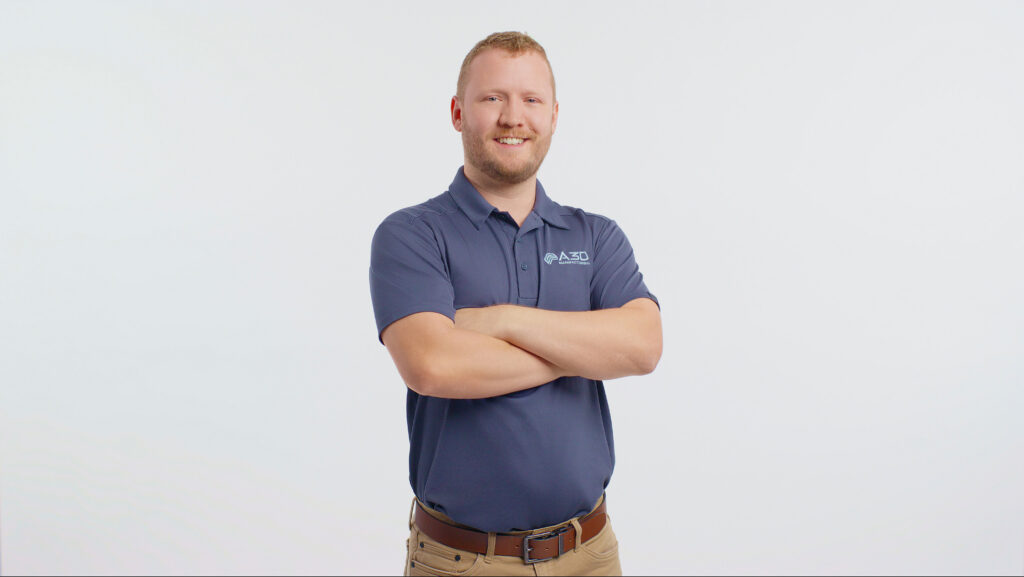
Meet Michael
Michael Dymond is A3D’s Product Manager and resident material scientist — but he almost ended up a neurosurgeon. He went to college aiming for the medical field, then read a book called How Doctors Think and realized much of modern diagnosis was becoming pattern-matching: key in the symptoms, let the system interpret the trends, follow the output.
“I didn’t want that. I wanted to be my own problem solver and have my own critical thinking.”
So, he pivoted to engineering — and then pivoted again. The field already had plenty of mechanical engineers, and the way Michael saw it, the next wave of innovation wouldn’t come from shape.
“The performance is almost capping out in terms of geometry. Any real big advancement is going to be what you make it out of instead.”
His material science lab had 3D printers, and his first job out of college was customer service at a manufacturing company doing exactly what A3D does. From there: customer service to inside sales to account manager, and then over to A3D — where he gets to pull from his formal materials training every single day.
1. The Art of Not Splitting Hairs
Ask Michael what the hardest part of material selection is, and his answer might surprise you: it’s appreciably simpler than most people think. The trick is getting customers to let go of requirements that don’t serve the outcome.
A common scenario: a customer insists their new part must be the exact same material as the last one — which would mean running samples through a mass spectrometer and multiple tests to reverse-engineer the precise formulation and additive ratios.
“I’m pretty sure you just need a Delrin. You’re going to be fine. We might spec out a thermal resistance to it — but so long as you’re in the correct classification of material, you’re going to have some really good success, and then do minor pivots from there.”
His coaching philosophy: focus on what the part needs to do, not what the old drawing says it was. “We need not split hairs here. You don’t need to spend the extra time, effort, and cost to suss out that last 2% of a part property. A little fudge factor is fine.”
2. “Why Is My Part Breaking?” — Anisotropy, Explained
Here’s a material science truth nobody asks about by name, but everybody asks about in practice. Customers don’t call asking about isotropic versus anisotropic properties. They call asking why the heck their FDM part is breaking.
The answer: it’s anisotropic. An isotropic material has the same properties — most importantly strength — in every direction. An anisotropic material doesn’t. FDM parts are way, way stronger in the X and Y directions than in Z, so a post printed standing vertically wants to snap and fall over. Failures can come appreciably early — around 40% sooner than the material data sheet would lead you to believe.
That’s why A3D coordinates with customers on build orientation: capitalizing on strength in X and Y, and on the better accuracy those directions usually offer too. Nobody’s asking the textbook question — but that’s the answer to the question they are asking.
3. Shining Signals at Stuff (or: What Spectroscopy Is Actually For)
Michael took an entire class in material science called characterization, which he summarizes with trademark precision:
“Seriously, 90% of characterization is shooting EM at something and seeing what EM comes back.”
Spectroscopy — shining signals into a material and reading the wavelength shifts, light rotation, and emission colors that come out — is how you find out exactly what something is, right down to the formulation. It’s also how astronomers know which elements exist in stars too far away to ever visit. (And because that light left the star thousands of years ago, you’re effectively looking into the past. Michael, a confessed space nerd, finds this delightful.)
For customer parts, though, his advice is usually: you don’t need it. Purchasing records and hand tools will tell you you’re holding a stainless 304 — you don’t need the exact chromium content of the last batch to get good results on the next one. He offers spectroscopy as an option, but A3D can normally get pretty darn close without it.
4. AI on the Workbench
Like every business unit at A3D, Michael’s workflow has an AI layer now — with a material scientist’s skepticism baked in.
His best use case is materials comparisons. When a customer wants the pros and cons of fiber-reinforced nylon versus going all the way to aluminum, he can set AI on a direct stack-up — work he used to do manually with a data sheet on each monitor, toggling back and forth for 15 minutes to draft a comparison. AI also helps structure answers to broad design questions, translating the 303-level nuance rattling around his brain into clean, 101-level recommendations.
But every output gets proofed, because:
“AI likes to say words that might not be true.”
Draft with AI, verify with the material scientist. In that order.
5. The Home Print Queue: Fellowship Weapons & Dungeon Terrain
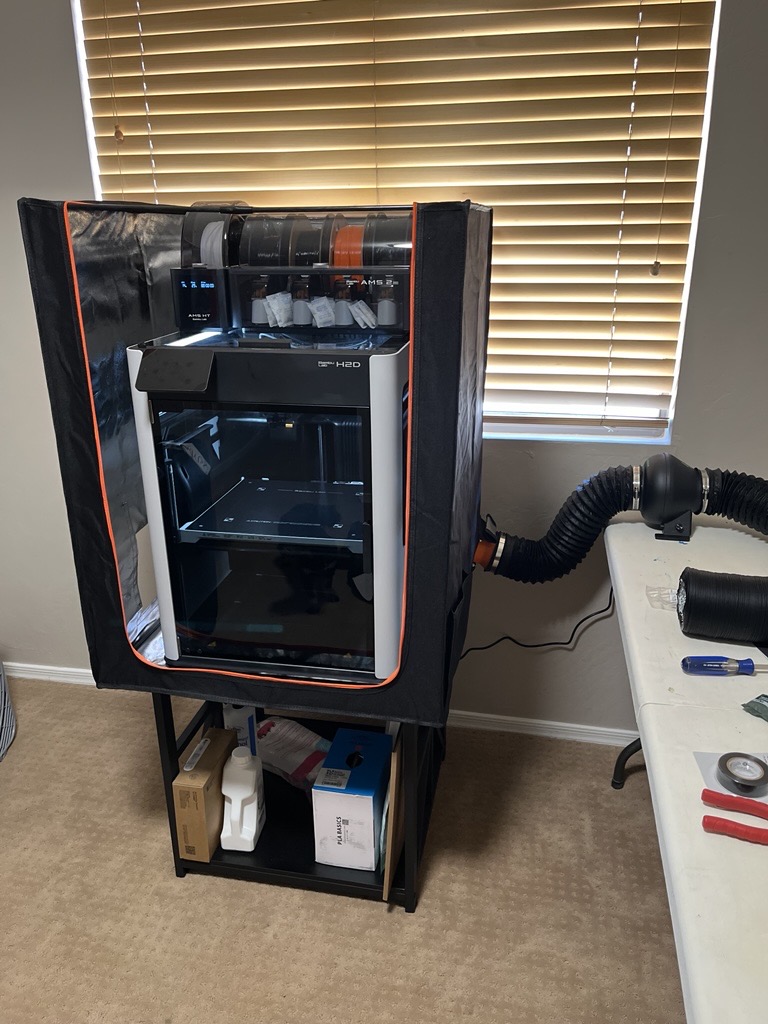
Michael recently added a Bambu Lab H2D to his home setup — a printer he’s hardly alone in choosing. “I go to a trade show and half the people that say they have a printer at home say it’s a Bambu. It’s taking the industry by storm.”
He’s observing the first law of new printer ownership: the first things you print are things for the printer. Desiccant holders, build tray organizers, hygrometer fixtures to monitor moisture in the filament box. From there, the queue gets more ambitious:
- The Fellowship project. Michael is working toward 3D printing all the weapons of the Lord of the Rings Fellowship — Gimli’s axe, Legolas’s bow — life-size, to scale, in multiple pieces on the H2D’s roughly 12-inch-square build plate.
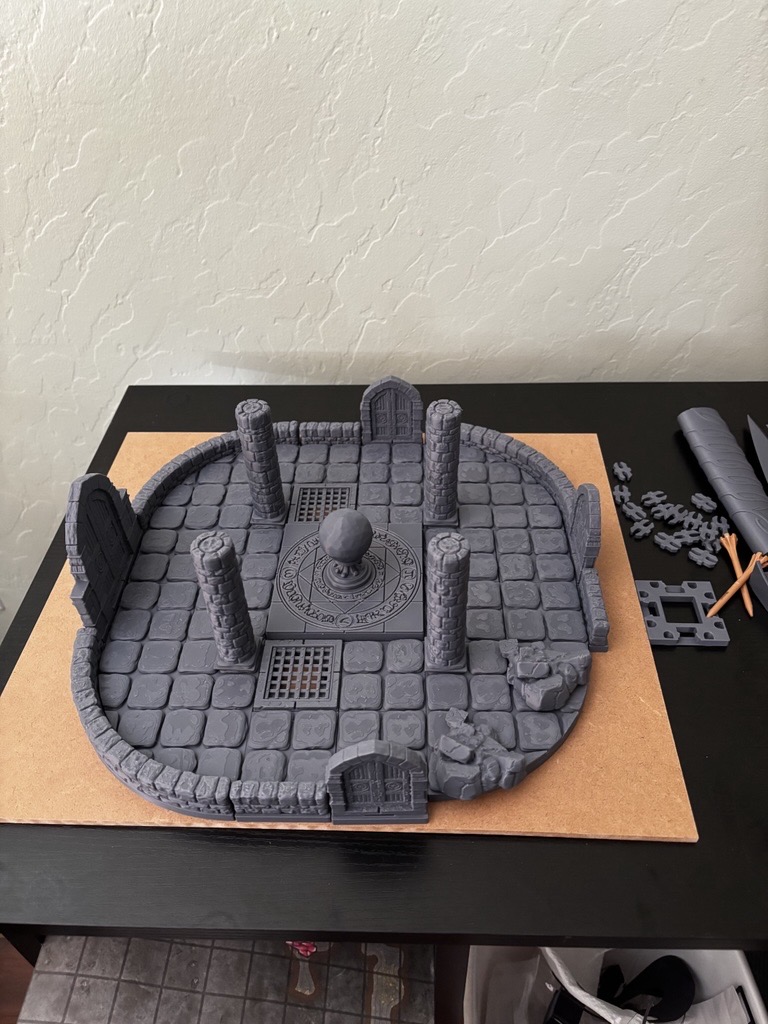
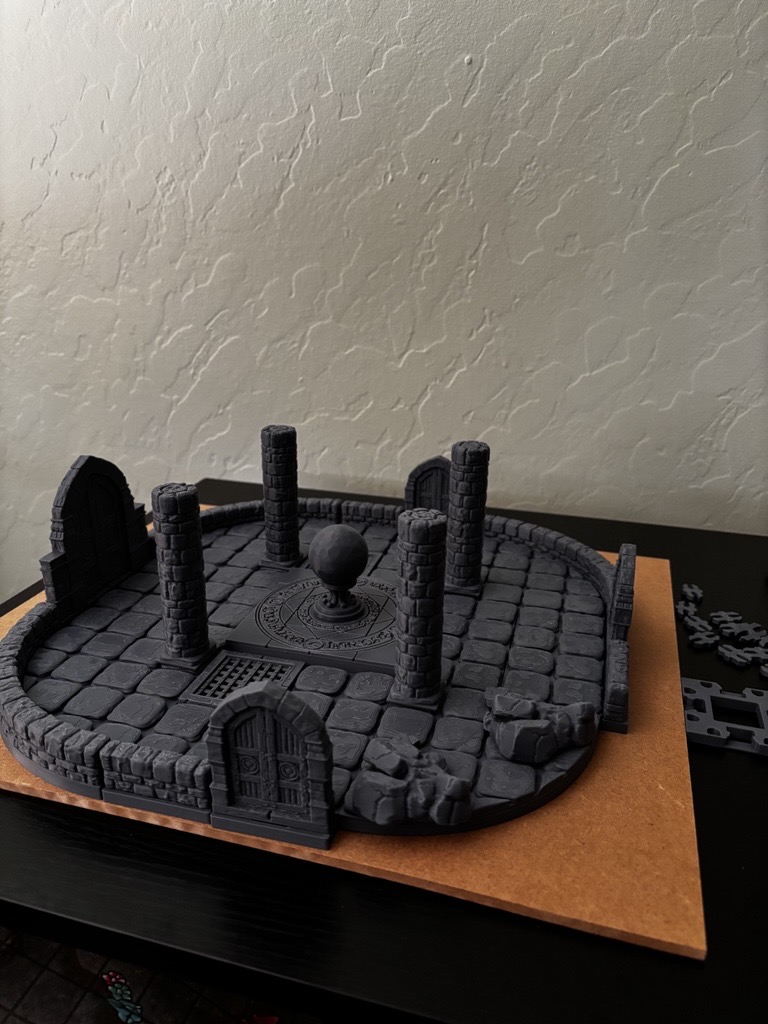
- Dungeon terrain. Setting pieces for the D&D campaign he runs as Dungeon Master — a heavily re-flavored Dragons of Stormwreck Isle, a sandbox where his party can encounter, negotiate, or fight their way through the island as they see fit.
And yes, he knows about the house rule at the A3D table: no talking about work in the game. As DM, he reserves the right to bend it: “I’m the DM. Whatever I say goes.”
(Michael, if you’re reading this: we’re still waiting on the miniature to rival Angel’s gold Cerakote mariachi bard.)
6. On American Manufacturing
Ask Michael about the state of US manufacturing and the first word he reaches for is camaraderie — especially in Phoenix, where building local means working with people whose hands you can shake, whose shop you can tour, whose parts you can pick up in person.
His honest critique: some of the traditional disciplines are slow to change, CNC machining chief among them.
“People have been CNC machining parts since someone could figure out how to spin an end mill. We’re always going to be CNC machining parts — that’s one of those things we’re not going to ever get away from until we have Star Trek-status replicators.”
Which is exactly why he thinks the field needs investment: continuing education, better tools and training, and above all an infusion of younger, energetic talent. He gives a shout-out to Titans of CNC for putting out content that makes the trade visible and exciting — the kind of subject-matter-expert education that could pull the next generation onto the shop floor.
Michael at Work: Quick Hits
Coolest Project
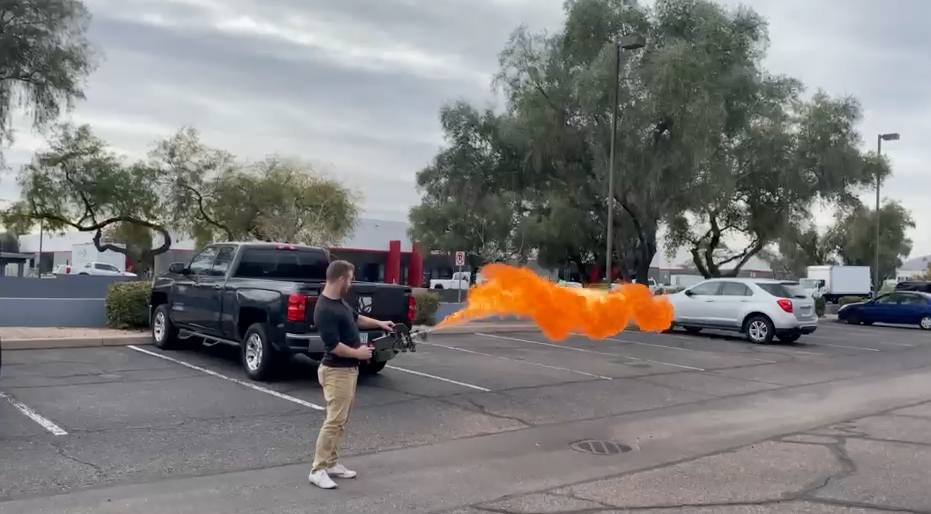
A forestry customer wanted to upgrade from the standard drip torches used for controlled burns, so A3D printed accessories and mounting solutions for a forestry flamethrower — then tested the finished part in the parking lot. It threw a 15-to-20-foot stream of flame, with heat you could feel blasting back at your face.
“No cops were called, no fire department was called that day.”
The Book Every Engineer Should Read
After a feint toward Corrosion and Corrosion Control (“corrosion is a multi-trillion dollar industry in terms of losses every year” — he wasn’t entirely joking), Michael lands on Emotional Intelligence 2.0. Engineers, he says fondly and as one himself, are not always the strongest people-people — and the book taught him to read the room, identify people’s strong suits, and adjust how he phrases things. He still takes it to heart today.
What He Wants to Learn Next
Inspection theory. It sounds mundane until he explains it: advanced GD&T concepts like LMC, MMC, and true positional profile; contact versus non-contact tools; measurement logic that lets you touch two features and mathematically back out a third; and statistical sampling that builds a confidence value so you can inspect nine parts instead of a hundred — and save yourself hours.
What Excites Him About the Future
Closing the materials gap. Put the encyclopedia of injection molding resins or CNC-machinable stock next to the catalog of 3D printable materials, and the additive one is tiny — polypropylene, for instance, prints in essentially one technology, in one flavor. Michael wants to see material scientists and process engineers grow that library.
Off the Clock
A full vegetable garden (Mexican gray squash, three kinds of hot peppers, tomatoes, basil, chives, and a stand of lavender for the pollinators — plus a garlic crop that refused to vernalize in a too-warm winter), flight-stick sessions in Star Citizen, and The Expanse, which he loves for its physics-honest space travel: accelerate for the first half of the trip, flip, and decelerate for the second. He’s plotting to drop Amos from The Expanse — “the epitome of lawful evil” — into a future D&D campaign as an NPC.
About Michael Dymond, Product Manager at A3D Manufacturing
Michael Dymond brings formal material science training to A3D customers every day — from first-call capability studies to final project reviews — helping engineers pick the right class of material and skip the expensive hair-splitting. When he’s not bringing customer projects across the finish line, he’s printing Middle-earth armaments, DM-ing his campaign, and coaxing garlic out of the Phoenix dirt.
Stay tuned for more A3D team spotlights and special side quests!
Ready to bring your ideas to life with expert support? Contact the A3D team today.