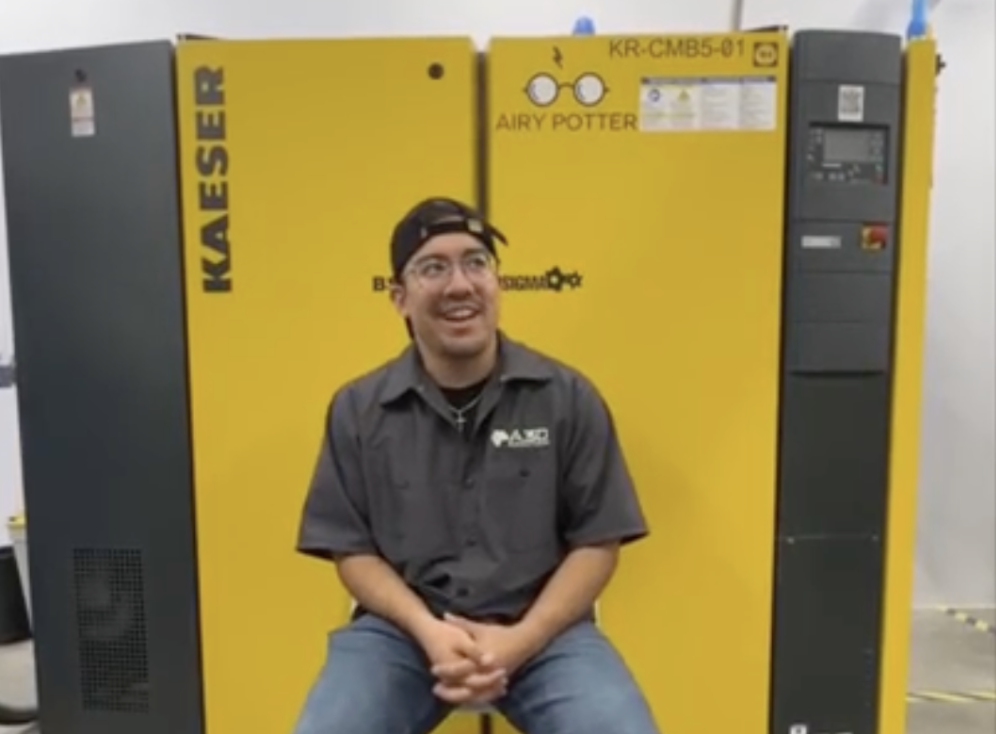
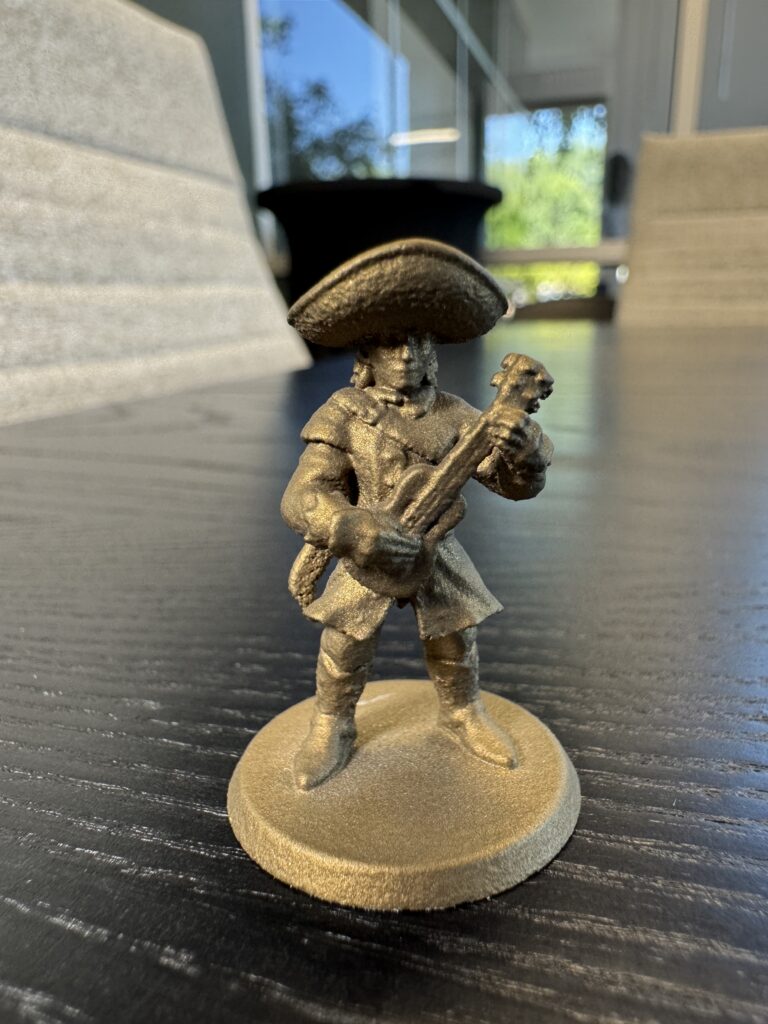
When Angel Campos isn’t making sure A3D’s customer parts ship out on time and in one piece, he’s at the table rolling dice with the office D&D crew. For his current character (an orc bard/ranger with a mariachi twist) he didn’t settle for whatever was on the shelf. He designed and printed the miniature himself, then finished it in gold Cerakote.
Meet Angel
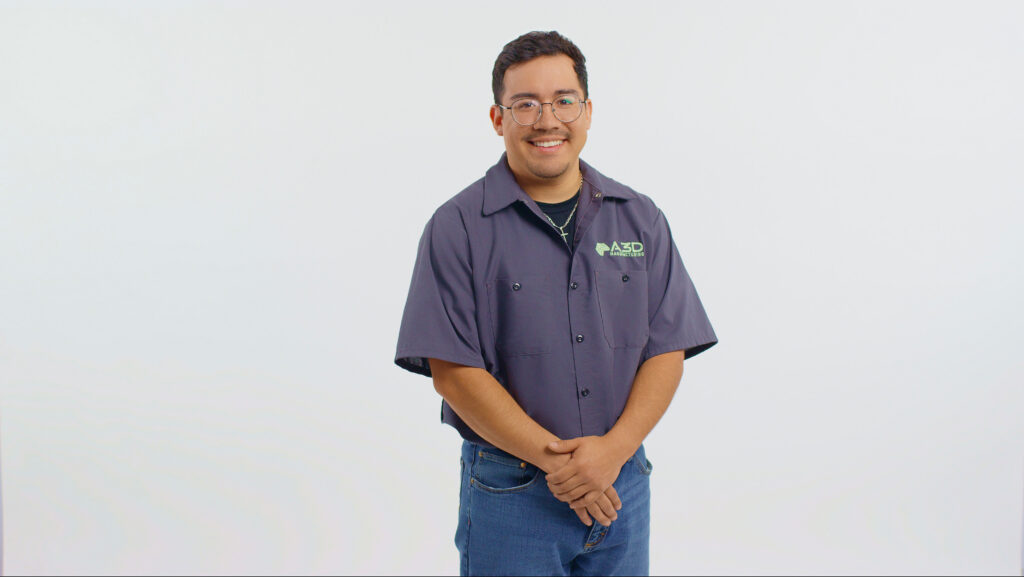
Angel Campos keeps A3D humming as the Shipping & Receiving Specialist — officially a 3DP Technician I. With certifications in CNC machining, he’s the last set of hands on every order: making sure parts get in, get processed, and ship out without a hitch.
It’s a job with very little room for error. “Making sure every order gets out the door and lands safely with the right customer” is the no-margin part of his daily process, and that attention to detail carries straight into how he approaches his own builds.
1. The Project: Custom D&D Tabletop Character
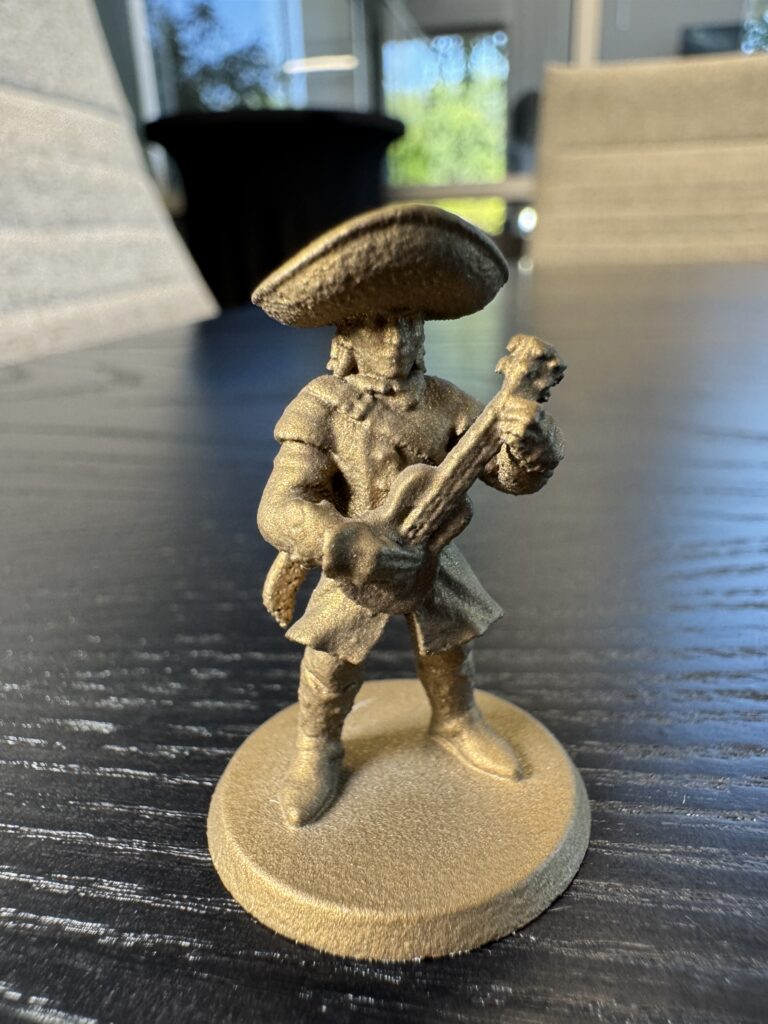
The miniature is a custom orc bard/ranger, designed to bring Angel’s character to life at the table. Rather than grab a generic mini off a store shelf, he built one infused with Hispanic cultural elements — honoring his heritage while staying true to the character’s adventurous, multi-classed spirit.
Why a Custom Mini?
In tabletop play, the figure on the board is a stand-in for hours of storytelling. Off-the-shelf minis are fine. But a mini that is your character — costume, weapon, posture, cultural cues — turns every encounter into something a little more personal. For someone whose day job is making sure customer parts come out exactly right, designing his own felt like the natural move.
The Campaign Context
Angel rolls with the office D&D group at A3D, where multiple coworkers play in a long-running campaign. Custom minis are practically the house style — but his is the only one wearing the sombrero.
2. Design Details
The character blends two classes into one figure. The orc framing brings the size and presence, the bard/ranger combo brings the storytelling weapons.
Cultural Elements
The sombrero is the most immediately visible nod to Angel’s heritage, but the styling threads through the whole figure — the silhouette, the costume drape, the proportions. It’s a character that could only have come from him.
Bard and Ranger, in One Figure
The miniature carries both a guitar/lute (the bard’s instrument) and a battleaxe (the ranger’s weapon), so it reads as the multi-class character it represents. Whether the next encounter calls for a song or a swing, the figure tells the right story on the board.
A Small But Meaningful Piece
Standard D&D miniatures are tiny — typically around 28mm tall — which means every feature on the design has to land. Sombrero brim, instrument strings, axe head, the folds of clothing: all of it has to survive being shrunk down and printed.
3. Build Details
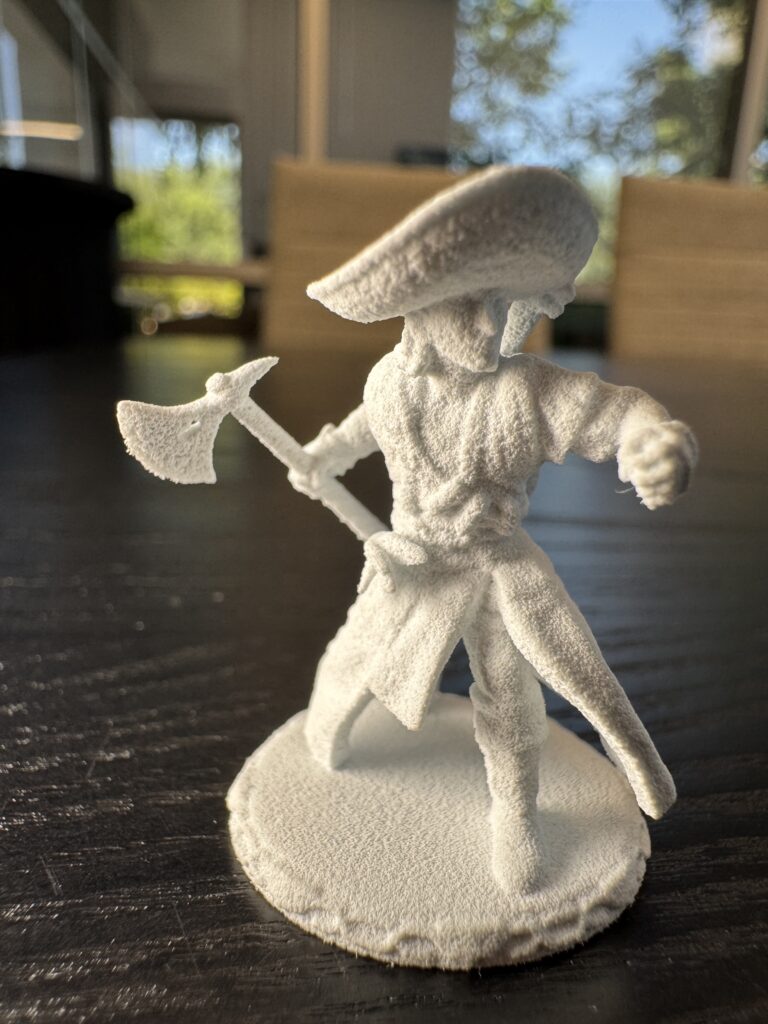
Once the design was set, Angel ran the part through the same workflow A3D uses on customer jobs every day — just on his own time, for his own character.
Print Size and Detail
Printing at miniature scale means every micron of layer resolution counts. The figure includes overhangs (the sombrero brim, the extended axe head, the lute neck) and fine features (face, hands, instrument strings) that would punish a less capable process.
Finishing Pass
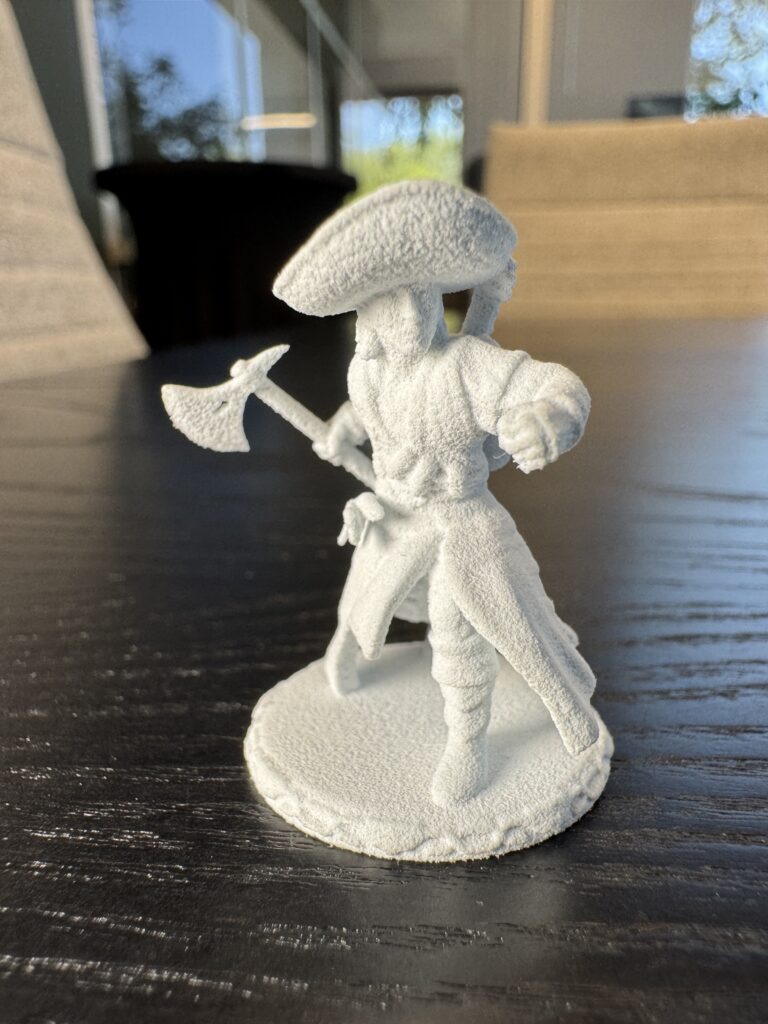
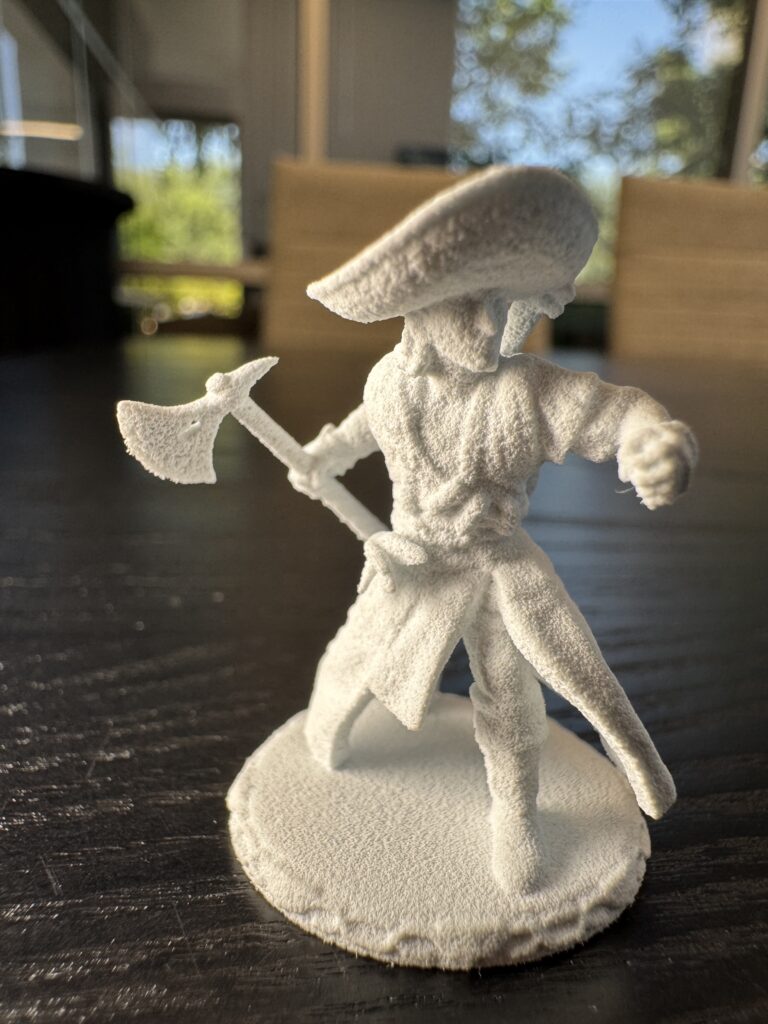
Out of the printer, the part comes in PA12 white — the bare, slightly grainy surface visible in the unfinished photos. From there, it goes through cleaning and gets prepped for paint.
4. Materials and Processes
- Print: PA12 White (MJF powder-based printing)
- Finish: Gold Cerakote paint
PA12 White
PA12 is the workhorse polymer for MJF. It captures fine detail, handles overhangs without support structures, and produces parts strong enough to actually use — which matters when a miniature gets picked up, dropped, and shuffled around the table every session.
The white base also gives any paint or coating on top of it a clean, neutral foundation. No bleed-through, no color contamination, no surprises.
Gold Cerakote
Cerakote is a ceramic-based coating better known from the firearms and automotive worlds, where it’s prized for durability, even color, and resistance to wear. On a tabletop miniature, it does something unexpected: it gives the figure a metallic depth that simple acrylic paint can’t quite match. The gold finish reads as cast metal at a glance, with the texture of the underlying PA12 print adding the kind of patina that makes it look like an artifact rather than a print.
Angel mentions silver might be next. For now, the gold is hard to argue with.
5. Why These Choices?
Why MJF PA12?
PA12 holds the fine details — face, hands, instrument strings, sombrero brim — that disappear on coarser processes. MJF prints don’t need supports, which means no scarring on the underside of the brim or where the axe meets the body. And PA12 is tough enough to survive actual play. A miniature that chips on its first session isn’t a hero — it’s a craft project. PA12 keeps it in the rotation.
Why Cerakote Over Standard Acrylic?
Acrylic paint is the tabletop default, and it’s perfectly capable. Cerakote is a step up: harder, more uniform, more resistant to the inevitable knocks. The metallic gold gives the figure visual weight that matches the character’s presence at the table.
Why This Workflow at All?
The same printers and finishing know-how A3D applies to customer parts translate one-to-one to a personal build. There’s no separate “hobby workflow” — there’s the workflow, applied to a smaller, more personal job. It’s a working example of using production-grade tools for side quests.
6. The Process in Photos
A walk through the build, from raw print to finished hero.
Angel at Work: Day Job
The same care he put into the miniature shows up at his actual job. Angel weighs in on the best parts of the day job:
Most Fulfilling
Once we have all the parts and ship them straight to the customer.
When the order lands neatly and on time, that’s the win.
Coolest Part
Seeing every part produced by the different types of machinery we run here.
A3D runs several different processes, so the work is never the same twice. “I’m always surprised by the cool and weird parts we produce here at A3D. It’s different every time.”
Trippiest Part
The packaging. Some parts are massive, some are tiny, and Angel has to figure out how to get every one of them out the door safely. The variety is the point — and the challenge.
What People Get Wrong
Angel’s parents think he’s somewhere melting plastic together. In reality, he’s working alongside some seriously large industrial machines; MJF, SLA, and FDM printers. Which is honestly a tough thing to picture until you’ve actually seen it.
What Might Surprise Customers
From the moment an order comes in – through blasting, cleaning, QC, and shipping – every step gets a thorough look. It’s not just one person seeing a part and sending it out. Multiple people touch each order to make sure it meets our standards before it ever leaves the building.
The same logic that runs through every customer order also ran through the miniature. Multiple steps, careful handling, and a part you can actually be proud of at the end.
About Angel Campos, 3DP Technician I
Angel Campos keeps A3D humming as Shipping & Receiving Specialist. With certifications in electrical apprenticeship and CNC machining, he makes sure parts get in, get processed, and ship out without a hitch.
Stay tuned for more A3D team spotlights and special side quests!
Ready to bring your ideas to life with expert support? Contact the A3D team today.