Most manufacturers are happy to make whatever you want, in whatever quantity you’ll pay for. A3D Manufacturing thinks that’s exactly how customers end up burned — overspending on parts that sit on a shelf forever, tooling up for volumes that never materialize, locked into a design decision they can’t undo.
In the first episode of Design, Validate, Scale — a new five-part fireside chat series from A3D Manufacturing and Hawk Ridge Systems — the pitch was a little unusual for a manufacturing company: sometimes the most valuable thing we can do is talk you out of making more.
Host David Whitten, an account manager at Hawk Ridge Systems, sat down with two A3D Manufacturing leaders to unpack it. Jon Toews is Senior Vice President and Head of A3D Manufacturing. He has more than 20 years across industrial design, architecture, and mechanical design. Michael Dymond is a product manager with a materials science background. He has over 6,000 projects behind him. The episode was about design. The most interesting parts were the counterintuitive ones.
Listen to the Discussion
🎧 Prefer to listen? Press play for the full 29-minute conversation.
Chapters
0:00 — Welcome & who’s who
4:53 — Why design decides everything
7:07 — The first question: “how many?”
8:19 — Additive: a production tool, not just prototyping
10:04 — What gets “baked in” — DFM & early mistakes
15:12 — Hybrid manufacturing: a strategy, not a technology
18:00 — Wrap-up & what’s next
19:34 — Live Q&A
The First Question Isn’t About Your Part — It’s “How Many?” (Volume Drives Design for Manufacturing)
- Quantity is the hinge — it points to additive, traditional, or hybrid
- Estimate volume honestly and early, even when it’s a range
- Low or uncertain volume favors additive and bridge approaches
- Stable, higher volume justifies tooling and traditional methods
“The first question is: how many?” — Michael Dymond, Product Manager, A3D Manufacturing
You’d expect a technical deep dive to start with performance criteria, tolerances, requirements. It doesn’t.
“Counterintuitively, that is not my first question,” Michael said. The first question is how many you need — because quantity quietly decides everything downstream. A run of 10 or 20 high-performance aerospace or defense parts gets designed around CNC machining or high-fidelity 3D printing. A consumer electronic headed for the hundreds of thousands gets designed around a completely different process from day one. The number most engineers treat as an afterthought is the one that dictates the design.
Guess it wrong and you don’t just pay more — you paint yourself into a corner. Lean all your DFM into injection molding or die casting expecting big volumes, then find out the real numbers point to CNC, and you’ve got an expensive problem right when you have pre-orders to fill or a trade show to hit.
The Most Honest Line: Common Early-Stage DFM Mistakes
- Cutting DFM corners to hit a prototype date
- Committing to one process before volume is known
- Ignoring downstream tolerances, materials, or finish
- Designing a part only one method can ever make
- Guessing demand instead of estimating it
Here’s how Michael made that concrete. Say you designed a part for die casting, but volume ends up pushing you toward CNC machining instead. Now a machinist has to program and cut a drafted die-cast part — with all the surfacing that involves — and, in his words, “CNC machinists hate to CNC machine and do programming for a drafted die-cast part.”
It’s not a strategy slide. It’s what actually happens on the floor when a demand guess goes sideways: real people, doing work they resent, to rescue a decision made months earlier in CAD. That’s the cost of getting the “how many” question wrong, and it’s the kind of detail you only hear from someone who’s shipped thousands of projects.
Design Forgiveness Runs One Way: Injection Molding vs. 3D Printing
- Early design choices lock in cost, lead time, and manufacturability
- Decisions made at the CAD stage ripple all the way to production
- Design for the current need and the future need at the same time
- Realistic demand estimates point you to the right method
- Lay a foundation that scales instead of one you have to rework
If there’s one nugget from the episode worth taping to your monitor, it’s this asymmetry: design a part properly for injection molding, and “nine times out of ten, that’s going to be a very 3D-printing-friendly part.” The reverse is not true.
Injection molding is the harder constraint. Design to satisfy it, and the easier path — additive — comes along for free, which means you can launch with 3D printing and scale into injection molding as relatively low-hanging fruit. Design loosely for additive first, though, and you may find there’s no clean road to the tooling you eventually need. Same two processes, completely different outcomes depending on which one you designed for first.
Additive Manufacturing Isn’t a Prototyping Tool — It’s a Production Hedge
- Development cycles are shorter and time to market matters more
- Lead-time pressure keeps rising to meet demand and schedule
- The additive question has shifted from “if” to “where and when”
- Supply chains need agility as demand and requirements shift
- Performance criteria, applications, and user feedback keep moving
Both guests were blunt: additive is not a prototyping tool anymore. With recent advances in materials and precision, it produces real end-use parts, not just jigs and mockups. But the more interesting reframe was financial.
A brand-new product that’s never been in the market is a bet. You don’t actually know your run rate yet. So why commit to an injection mold that might run you $30,000 before you have a single data point? As Jon put it, additive lets you go to market first and “elongate that additive stage as long as you want” — until you’ve built real confidence in demand — then transition to injection molding, or take a middle step like cast urethane along the way. For a lean company seeding a new market, additive isn’t a compromise. It’s a way to avoid making an expensive bet before you have to.
Loud Customers and Design Agility With 3D Printing
“In 2026, customer bases are loud and will let their feedback be known. Being able to field that feedback and just send a new file to the 3D printer to satisfy the masses — that agility has real value.” — Michael Dymond, Product Manager, A3D Manufacturing
There’s an agility payoff, too, and Michael framed it in a way that felt very 2026: customers are communicative, and they’ll tell you fast if a first release misses the mark. The advantage of additive is that you can get a flagship product out, listen to that feedback, and “just send a new file to the 3D printer” to fix it.
Manufacturing as something reactive and conversational — ship, listen, revise, resend — rather than a decision you cast in tooling and pray about.
Hybrid Manufacturing Is a Strategy, Not a Technology
- Hybrid is a strategy, not a single technology
- Combine additive and traditional across one BOM or across the lifecycle
- Start additive for speed, move to traditional as volume grows
- Design so you can flex methods later instead of locking in early
- Keep the best method available at every stage
All of this rolls up into what A3D Manufacturing and Hawk Ridge Systems call hybrid manufacturing — a term Jon was careful to define, because “it probably means 10 different things to 10 different people.”
For A3D Manufacturing, it isn’t a machine or a process. It’s a strategy: look at where a product sits in its lifecycle and pick the right process for each part, across the whole assembly, at each point in time. One part might want additive because it’s still changing often. A metal part in the same assembly might be best on CNC — which still makes the vast majority of accurate metal parts and, in Jon’s view, isn’t going anywhere. A third might justify injection molding. Choosing additive for one part says nothing about the next.
And that’s the thread back to the opening. A3D Manufacturing would rather pick the exact right process for each part — even when that means recommending you make fewer, or spend less — because their bet is on the long game. When a customer profits, takes their product to market, and reinvests, they come back. One project becomes a lifelong partnership. That only works if you’re willing to tell customers the truth about what they actually need.
Frequently Asked Questions
What is design for manufacturing (DFM)?
Design for manufacturing is the discipline of designing a part with its production method in mind from the very first CAD decision. In Episode 1, the A3D Manufacturing team stressed that choices made at the design stage lock in cost, lead time, and manufacturability all the way to production.
Is additive manufacturing (3D printing) only for prototyping?
No. Both A3D Manufacturing leaders were clear that additive is no longer just a prototyping tool — with today’s materials and precision it is a full production method when it is the right fit, producing real end-use parts rather than only jigs and mockups.
When should you use 3D printing versus injection molding?
It comes down to volume and certainty. Low or uncertain volumes favor additive and bridge approaches, while stable, higher volumes justify injection-mold tooling. Additive also lets you reach the market without committing to expensive injection-mold tooling before you know your run rate.
What is hybrid manufacturing?
Hybrid manufacturing is a strategy rather than a single technology. It means choosing the right process — additive, CNC, or injection molding — for each part across an assembly and across the product’s lifecycle, instead of forcing everything through one method.
Why does production volume matter so early in the design process?
Because quantity dictates the manufacturing method, which in turn dictates the DFM rules you are locked into. Guessing demand wrong can force an expensive redesign at the worst possible time — right when you have pre-orders to fill or a trade show deadline.
Watch the Full Fireside Chat: Episode 1, Ideation & Design
Want the full visual session with the slides? Sign up to watch the complete fireside chat — it takes a few seconds.
Coming Up in the Design, Validate, Scale Series
First, the key takeaways from Episode 1:
- Design decisions shape cost, speed, and manufacturability first
- Apply DFM early and design for the method your demand points to
- Keep hybrid on the table — preserve your options as you go
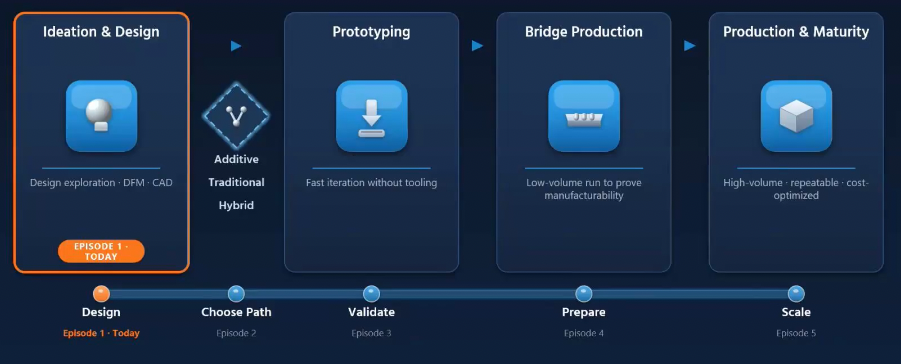
Episode 1 was about design. The next four follow the rest of the production lifecycle — prototyping, bridge production, and full mass production. Register here and you’re in for all five, and every session is available on demand.
If your team is staring down any of these calls — first manufacturing method, or scaling something that’s already working — that’s the conversation A3D Manufacturing and Hawk Ridge Systems are built for. Talk to your account manager to get started.